

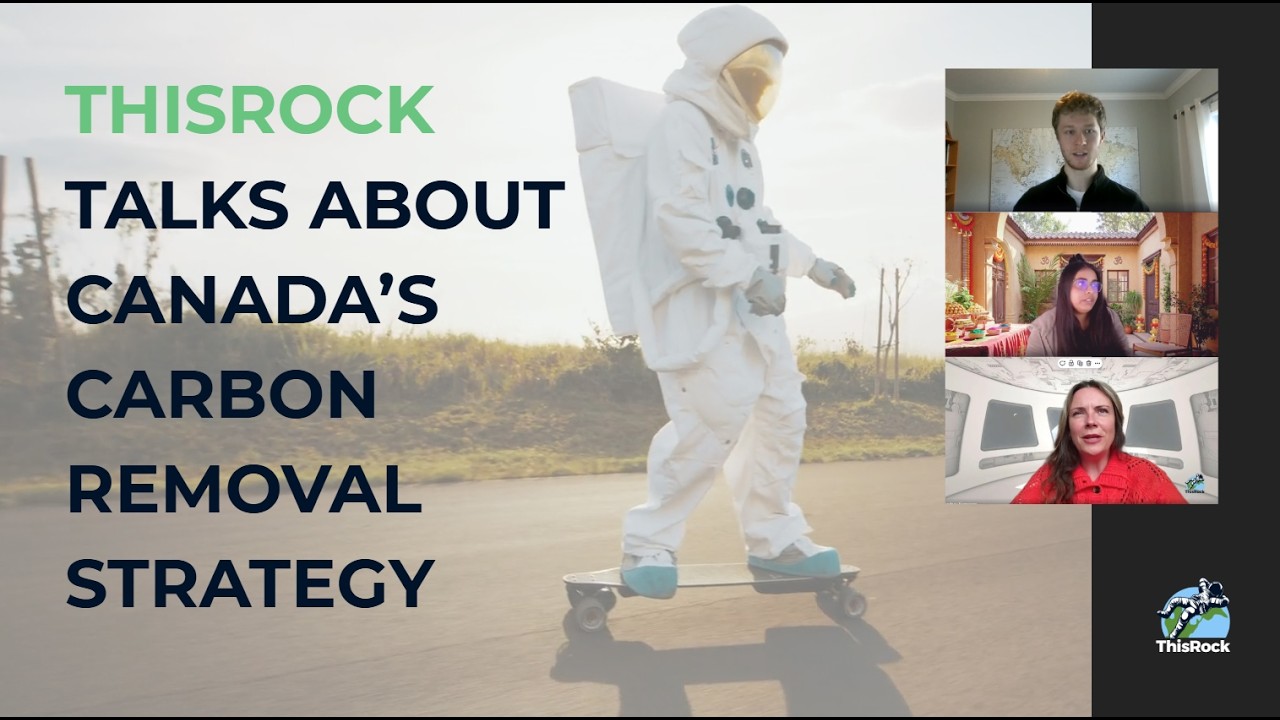
Stephen Rainer on our team at ThisRock attended Carbon Removal Day 2026 in Ottawa. The event made one thing unmistakably clear: Canada is no longer exploring carbon removal, rather it is positioning itself to lead it.
The combination of a new $100M public‑private coalition, strong federal messaging, and alignment with national modelling shows a coordinated national push.
Carbon removal is shifting from “if” to “how fast and how big.” This blog is meant to summarize our notes and lessons from the event for you.

1. The $100M Carbon Removal Coalition
The announcement of the Advance Carbon Removal Coalition (backed by BMO, RBC, Shopify, Vancity, and the Government of Canada) is a pivotal moment.
Why this matters
- It creates real demand, which is the missing piece for scaling projects.
- It de‑risks early buyers and investors.
- It signals to global markets that Canada intends to lead.
- It aligns with the Blueprint’s call for early procurement and demand‑side support.
This is the strongest federal signal yet that carbon removal is becoming part of Canada’s industrial strategy.
2. Canada’s North Star: 1 Billion Tonnes by 2050
Canada’s modelling shows 171 MT of carbon removal per year will be needed domestically by 2050 to reach net‑zero affordably.
At the same time, Canadian technology and project development could enable over 1 billion tonnes of removals globally each year by mid‑century.
This isn’t just climate ambition. It’s the foundation for building a new trillion‑dollar industry.
3. Carbon Console: The National Dashboard
The Carbon Console is becoming the central tool for:
- Tracking projects
- Understanding technology maturity
- Identifying regional strengths
- Monitoring planned vs. operational capacity
This is essential because the industry’s biggest challenge is turning planned tonnes into delivered tonnes.
4. Where the Early Market Opportunities Are
You captured the sectors that are most “removal‑ready,” which align with the modelling:
- Pulp & Paper – BECCS, biomass carbon removal
- Mining – mineralization, tailings carbonation
- Forestry – biochar, biomass aggregation
- Steel – residual emissions + mineralization
- Energy – DAC powered by clean grids
These industries already have the feedstocks, infrastructure, or emissions profiles that make them early movers.
5. What the Market Needs Right Now
Across the event and the reports, three priorities came up repeatedly:
Build Trust
- High‑integrity MRV
- Clear standards
- Public and Indigenous engagement
- Transparent verification
Lower Costs
- First‑of‑a‑kind support
- Learning‑by‑doing
- Shared infrastructure (pipelines, storage hubs)
Increase Demand
- Government procurement
- Corporate buyers
- Integration into compliance markets
This aligns directly with the “Prove → Scale → Export” framework guiding Canada’s carbon removal strategy.
6. Why Canada Is Attracting Global Investors
Canada’s political stability is a competitive advantage.
Foreign investors choose Canada because:
- Climate policy is durable
- Clean electricity is abundant
- Geological storage is world‑class
- Carbon pricing is predictable
- Institutions are trusted
This is exactly what the Billion Tonne Blueprint calls Canada’s “unique ingredients for leadership.”
7. The Minister’s Message: This Is Economic Policy
Julie Dabrusin emphasized that carbon removal is now part of Canada’s:
- Fiscal strategy
- Economic competitiveness strategy
- Intergenerational responsibility
The $100M coalition is not a one‑off. It’s a directional signal.
8. The Market Outlook: A Trillion‑Dollar Industry
Carbon removal is projected to become a $1 trillion global market.
A key takeaway from the event was clear:
“Those who wait will end up buying from those who build now.“
Canada already has:
- The 4th highest number of carbon removal companies (85 Companies)
- A strong innovation ecosystem
- Early leadership in DAC, mineralization, BECCS, and ocean CDR
9. Industries That Will Benefit Most
Canada’s modelling highlights several sectors that stand to benefit most from the growth of carbon removal:
- Engineering – design, integration, retrofits
- Construction – building facilities, pipelines, storage
- Clean supply chains – low‑carbon materials, logistics
These are job‑rich sectors that could see major growth.
10. Canada’s Climate Competitiveness Strategy
Your notes match the federal strategy pillars:
- Certainty for buyers
- Strong carbon pricing
- Tax credits (DAC, BECCS, clean electricity)
- Methane standards
- Clean electricity grid vision
These pillars matter because they create the long‑term stability, predictability, and investment confidence needed for carbon removal to grow from early projects into a major industrial sector.
11. The Shift in Business Mindset
A major theme from the fireside chat:
- Carbon removal is no longer an afterthought
- Companies are preparing for border adjustments
- Climate action and economic growth are now seen as linked
- Canada’s “special sauce” is clean tech + stable policy
Even if other countries slow down, Canada can leapfrog.
12. Where Projects Should Be Built
Canada’s advantages for building and scaling carbon removal projects come down to three essential ingredients:
- Good geology – Alberta, Saskatchewan, Atlantic offshore
- Skilled workforce – trades, engineering, operations
- Full value‑chain capability – biomass, minerals, pipelines, storage
This mirrors the regional strengths outlined in Removals into Revenue.
13. Technology Landscape: Beyond Nature‑Based Solutions
Canada is advancing a wide range of carbon removal pathways, each already active across the country:
- Ocean alkalinity enhancement
- Direct ocean removal
- Enhanced rock weathering
- BECCS
- Direct air capture
- Biochar
- Carbon mineralization
- Biomass burial
Canada is one of the few countries with natural advantages across all of these approaches, giving it the ability to develop, test, and scale multiple high‑integrity carbon removal solutions in parallel.
14. Companies Leading the Charge
- Arca – mineralization in mine tailings
- Undo – enhanced rock weathering
- CarbonRun – river alkalinity enhancement
- Deep Sky – DAC and CDR project development
These companies are already attracting global attention and securing major partnerships, positioning Canada as a serious contender in the emerging carbon removal economy.
15. Canadian Carbon Removal in Action
Algoma Steel
- Converted blast furnaces to electric arc furnaces
- Reduced emissions from 4 Mt → 1 Mt
- Largest industrial reduction in Canada
- Exploring carbon capture from steel byproducts
Crawford Nickel Project
- Largest nickel sulfide project globally
- Designed to be the first net‑zero nickel mine
- Uses mineralization to store CO₂ in ultramafic rock
Together, these examples show how carbon removal is becoming a practical tool for decarbonizing heavy emitter industries.
16. Why Canada Is a Global Opportunity
Canada’s major assessments point to several consistent themes:
- IPCC identifies CDR as essential
- Companies are getting serious about removals
- Canada has unmatched geology (sedimentary + ultramafic)
- Conservative estimates: 40 years of global emissions storage potential
- Easier to build projects in one regulatory environment
This combination is why Canada is increasingly viewed as a future global hub for carbon removal.
17. Long‑Term Storage and Permanence
Canada’s advantage becomes especially clear when you look at permanence:
- Some worry about leaks in long‑term storage
- Mineralization (turning CO₂ into rock) is the most permanent solution
- Canada has ideal geology for this
This gives Canada a major competitive edge in building durable, high‑integrity carbon removal.
The Core Takeaways
- Canada is officially open for carbon removal business.
- A $100M coalition is now mobilizing demand and capital.
- Carbon removal is becoming a major economic pillar, not a niche climate tool.
- The goal is 1 billion tonnes by 2050, and the path is Prove → Scale → Export.
- Canada’s stability, geology, clean power, and institutions give it a real shot at global leadership.
- The next 5 years are decisive.
Ready to Tackle Carbon Removal With Confidence?
You don’t need a massive strategy document to get started. You need structure, clarity, and confidence in your data and decisions.
At This Rock, we help organizations:
- Identify material sustainability and climate topics
- Organize and validate ESG and emissions data
- Align to global frameworks and emerging CDR guidance
- Strengthen ratings such as EcoVadis
- Build credible sustainability and climate reports that support growth
If customers, investors, or partners are asking about your climate strategy or carbon removal plans, now is the time to act.
Book a free 15‑minute introductory call with Lindsay at ThisRock and start building a carbon removal‑ready strategy that keeps you competitive and positioned for long‑term success.


